
















Smoking times and temperatures
I keep this as a planning sheet. It has been wrong, in both directions, on my own pit. A twelve-pound brisket has finished in ten hours and it has taken fourteen. Use the ranges to tell people when to arrive. Use a thermometer and a probe test to tell the meat when it is done. The method, why the temperature sits still in the middle, is low and slow. This page is the numbers.
The ranges I use
| Meat | Pit | Done when | Time I plan |
|---|---|---|---|
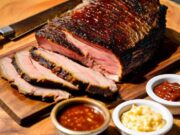
| Brisket, whole packer | 250°F | 200–205°F and the probe slides | 10–14 hours, plus a rest |
| Pork shoulder, 7 lb | 250°F | 200–205°F, bone loose | 8–10 hours, plus a rest |
| Spare ribs | 250°F | they bend and crack | 6–7 hours |
| Baby back ribs | 250°F | they bend | 4–5 hours |
| Turkey, 12 lb | 275°F | breast 155°F, thigh 175°F | 3–4 hours, plus a rest |
| Chicken thighs | 300–350°F | 165°F in the thigh | 45–75 minutes |
The cooks behind the rows are brisket, pulled pork, ribs, turkey, and chicken. Safety temperatures, which are not the same as tenderness temperatures, are food safety. A pork chop is not on this chart. A chop is a hot, short cook on its own page.
Resting is part of the time. A brisket sliced the minute it leaves the pit wastes the morning. An hour in a dry cooler is the minimum I give it. If your pit runs hot, every number in the time column shrinks and the meat gets worse, not faster in a useful way. Fix the fire first. That is temperature control.