


















The meat thermometer I trust
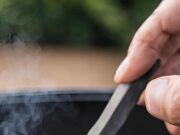
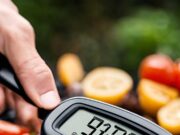
I owned a dome gauge for two years and believed it. It said 325°F while a grate-level probe said 240°F. The chicken agreed with the probe. Since then I use two tools: a fast instant-read for the meat, and a leave-in probe for the pit. Everything else on the lid is decoration.
Where the tip goes
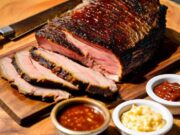
Thickest part, not touching bone, not touching the pan, not poked in from the top so shallow that I am measuring the crust. On a brisket that is the flat, in a few spots, because one corner can be done while the middle is not. I wrote the whole cook at smoke a brisket. On a chop or a steak, I go in from the side, horizontally, so a thin piece still has the sensor in the center. Going in from the top on an inch-thick chop is how you measure the grate.
I pull pork chops at 140°F and let them rest. Steaks come off depending on who is eating, and the method is grilling a steak. Poultry I take to 165°F in the thigh, not in a dry bite of breast if the thigh is still behind. Those numbers, and the ones that are about tenderness rather than safety, are on food safety and on the time and temperature chart.
The mistakes that made me buy a better one
I used to cut a slit to look. The juice left, and I still learned nothing, because air grays the color in a second. I used to trust a dial thermometer that took twenty seconds and had a sensor an inch up the stem, so the tip was in the meat and the sensor was in the air. I used to leave an instant-read in the oven. They are not all built for that. The leave-in probe stays. The instant-read lives in the pocket and comes out for the check.
I also used to average three bad readings and call it data. If one spot is 20 degrees colder, that spot is the cook. The rest of the meat can wait for it.
Pit temperature is a different probe
Clip it at grate height, near the meat, in the air, not buried in a roast. A probe in the meat does not tell you what the fire is doing. When the stall hits on a brisket, the meat temperature sits still while the pit can be perfectly fine. If you crank the fire because the meat “stopped,” you will shoot past the stall into a dry flat. Holding the fire steady is temperature control. The thermometer only tells you whether you managed it.
I do not have a yearly ranking of gadgets. I have one instant-read that answers in two or three seconds and one pit probe with a wire that has survived a lid. If either one starts to wander, I check it in ice water. It should read 32°F, or close enough that I know the error. If it is off by ten degrees I stop using it. A confident wrong number is worse than no number, because you will serve the chicken.