


















How I get a crust
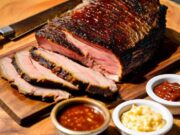
A gray steak with grill marks is not a sear. Grill marks are two hot lines and a lot of steamed meat between them. The crust I want is brown across the face, from the meat itself going dark in a hot dry pan of air. The name for that browning is the Maillard reaction. I do not need the chemistry lecture to cook it. I need the surface dry, the grate hotter than is comfortable, and the patience to not move the meat for a minute.
Dry, salted, oiled a little
Wet meat steams. I pat steaks and chops with a towel until the towel comes away damp and the surface looks dull. Salt goes on ahead of time if I can, at least forty minutes, or right before they hit the grate if I cannot. Pepper can burn on a truly ripping fire, so on a hard sear I pepper after, not before. A thin film of oil on the meat helps contact. A pool of oil on the grate starts the flare that tastes like a drip pan.
This is direct heat. If the coals are banked to the side, you are not searing. You are baking with ambition.
Leave it alone, then decide
Down on the grate. A full minute before I touch it, sometimes ninety seconds if the piece is thick and the fire is right. If it sticks, it is not ready to turn. If I rip it up early I leave the crust on the bars, which I have done while someone watched. The second side gets less time, because the interior is already climbing. I check with the thermometer from the side. For the steak temperatures I actually pull at, see grilling a steak. For chops, pork chops.
Sugar and searing do not mix. Sauce at the end, off the hardest heat, or the crust you built becomes black sugar. The sweet sauce is for that last brush, not for the first minute.
Reverse sear, which I use on thick steaks
On anything over an inch and a half, a hard sear from raw often leaves me with a brown band and a cold stripe, or a perfect crust and a center I overshot while the second side finished. So I cook the steak on the cool side first, lid on, until it is about 15°F under the target. Then it goes over the coals for a minute a side. The crust happens fast because the inside is already warm. That is reverse sear. It is not a different religion. It is the same crust, delayed until the middle has caught up.
I do not reverse-sear souvlaki, or thin skirt, or burgers. They do not have a middle that needs a head start. Those are a hot grate and attention, which is ordinary searing, and it is enough.